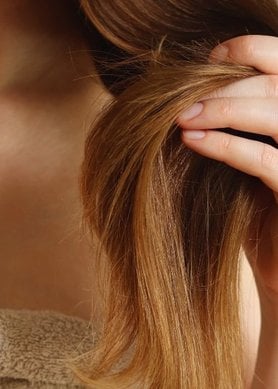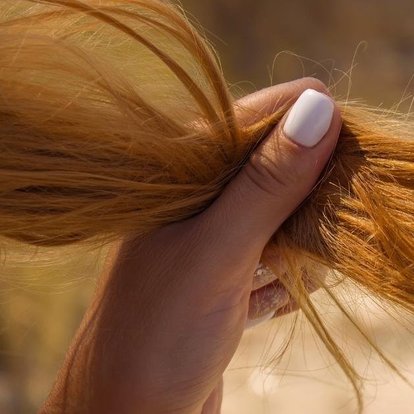
Split ends are one of the most common hair concerns out there and usually the result of damage building up over time – rather than one single cause. This why few people know how to prevent split ends from forming in the first place.
Below, we break down what causes split ends, and cover how to identify, manage, and prevent them with expert hair care solutions and strategies from Dercos.
What are split ends?
Every strand of hair is wrapped in a protective outer layer called the cuticle. When that layer wears down or breaks, the softer core underneath is exposed – and the strand splits at the tip. That's a split end.
Split ends are one of the most common signs of hair breakage and usually show up first at the oldest part of your hair, since the ends have clocked up the most sun, heat, and styling over time. Left alone, the split can travel further up the shaft and lead to more damage.
What do split ends look like?
The easiest way to check is to hold a few strands up to the light and look closely at the tips. If you spot a strand forking into a ‘Y’ or ‘V’ shape, you have found a split end.
You'll usually notice a few other tells too: hair that feels dry or straw-like at the ends, strands that tangle the moment you pick up a brush, and a tendency for hair to frizz or look "fluffy" rather than sleek, especially at the ends.
What causes split ends?
Split ends are the result of built-up damage – every brush stroke, blow-dry, and beach day leaves its mark on the hair fibre. Read on as we explain the most common culprits behind what causes split ends.
Heat styling
Straighteners, curling tools, and high-heat blow-drying all work the same way: forcing moisture out of the hair fibre faster than it can be replaced. Do this often enough, and the hair starts to lose its natural elasticity, becoming drier and more rigid, and more likely to split.
Bleaching, colouring and chemical processing
Bleaching, colouring, perming, relaxing, and chemical straightening all work by opening the hair cuticle to change its structure, compromising its ability to hold onto moisture. Each treatment leaves the cuticle a little more open than before, and repeated processing wears it down further. Repeat this enough and you can begin to lose hair density and volume as hair becomes thinner and weaker.
Mechanical damage
Rough brushing, detangling, towel-drying, and tight hairstyles – especially slicked-back buns – create friction and tension on your hair.
Hair is at its most fragile when wet, as the cuticle is raised and the fibre stretches easily. This makes wet hair more vulnerable to breakage and splitting, so rough handling post-shower can contribute to split ends more readily than the same habits on dry hair.
Sun, chlorine and salt water
An Aussie summer of ocean dips, pool days, and long hours in the sun can be harsh on your hair: UV exposure, chlorine, and salt water all rob your hair of moisture and weaken the fibre. It's why strands can feel rough, dry, or straw-like after a day at the beach or pool – leaving hair dehydrated, damaged, and primed to split.
Can you repair split ends?
Not completely, no. Once a hair fibre has physically split, cutting it off is the only way to remove it. What hair care can do, however, is slow things down before they get to that point.
Our Collagen Peptide 17 Ultra-Repairing range works by coating the hair with collagen peptides – tiny protein fragments that settle onto the surface of each strand and fill in the rough, weakened spots left by damage. Used consistently, the formulations in our Collagen Peptide 17 Ultra-Repairing collection smooth the hair's outer layer and make it more resilient, so split ends are less likely to form as your hair grows out.
How to prevent split ends: 7 strategies
The best way to deal with split ends is to stop them from forming at all. Hydrated hair with good vitality is naturally stronger and far less prone to splitting, which makes a few simple changes to your routine one of the most effective things you can do. Below, we detail our seven strategies on how to prevent split ends.
1. Care for your scalp
A balanced scalp microbiome – the natural mix of bacteria and oils on your scalp – helps produce sebum, which coats each strand and keeps it hydrated and resilient as it grows. When that balance is off, hair can grow out drier and more prone to splitting, which is why a good hair care routine starts at your scalp.
Our Collagen Peptide 17 Ultra-Repairing Treatment preps hair before washing, delivering a concentrated dose of collagen peptides to help rebuild weakened bonds. Follow with the Collagen Peptide 17 Ultra-Repairing Shampoo, which lifts scalp buildup while layering in even more collagen peptides – leaving your hair better able to resist breakage and split ends.
2. Condition your lengths and ends
Conditioner improves manageability, reduces friction between strands, and helps prevent dry hair, which is what causes split ends in the first instance. Focus application on your mid-lengths and ends, massaging conditioner in where hair needs hydration most.
For hair that's already brittle or damaged, use our Collagen Peptide 17 Ultra-Repairing Conditioner as a targeted treatment, leaving it in for five minutes to help improve softness and elasticity while protecting against further breakage.
3. Get regular trims
Regular trims remove existing split ends before they have the chance to fray further up the hair shaft, stopping small damage from turning into a bigger cut down the line. Booking in every eight to 12 weeks is the sweet spot for split end prevention – often enough to stay ahead of damage, without sacrificing your length.
4. Limit excessive heat styling
Cut back on heat styling where you can and lean on lower temperatures or heatless styles – like braids or rollers – whenever the look allows. When you do reach for hot tools, a heat protectant is a non-negotiable. In addition, try to avoid passing over the same hair more than once – repeated heat compounds the damage, drying strands out further and making them more likely to split.
5. Space out chemical treatments
If split ends keep showing up no matter what you try, it might be worth pressing pause on chemical services altogether – a six-month break can give your hair time to recover. Use that window to focus on strengthening and conditioning instead.
Not ready for that big a gap? Use this as a general guide instead:
- Virgin hair can handle four to six weeks between appointments.
- Previously coloured hair does better with four to eight weeks.
- Hair that's already extremely dry or damaged should stretch to eight to 12 weeks.
6. Be gentle when brushing and drying your hair
Be gentle with your hair. Detangle from the ends upward rather than dragging a brush straight from root to tip and reach for a wide-tooth comb when hair is wet and at its most fragile. Skip the aggressive towel rub in favour of blotting with a microfibre towel or soft cotton fabric – and ease off tying your hair into very tight styles day after day.
7. Protect your ends from environmental damage
Rinse your hair as soon as possible after a swim, whether it's a pool or the ocean, before chlorine or salt has time to settle in. And just like your skin, hair can get sun damage too – a bandana or hat is an easy way to shield it on long days outside. As part of a summer hair care routine, try double conditioning: applying, rinsing, then repeating gives hair extra time to reabsorb the moisture that it has lost.
Split end prevention relies on hydration. Next, learn about the hydration powerhouse that is niacinamide, and how it can benefit hair.