Whether you’re in a constant struggle with dandruff or seeking early prevention tips, anti-dandruff shampoo is the most effective management tool for this common scalp concern.
But how does anti-dandruff shampoo work?
If you’ve ever wondered about using dandruff shampoo and how it works, you’re in good company – and you’re in the right place. Below, we’ll be lifting the veil on key anti-dandruff ingredients: exploring how to choose the right anti-dandruff shampoo formula for your scalp, and how often you should be washing your hair. Read on for our expert scalp advice.
How dandruff forms
Before we break down how anti-dandruff shampoo works, it’s important to understand how dandruff forms. Our scalp microbiome is a delicate ecosystem filled with bacteria and yeast, and dandruff is triggered by three key factors:
- The presence of natural yeast on your scalp
- How much sebum your scalp produces
- Your scalp’s sensitivity to oleic acid (a fatty acid)1
Natural yeast is something we all have, but it feeds on sebum and produces oleic acid1. If your scalp is sensitive to oleic acid, your skin cell turnover tends to speed up, as it tries to get rid of the fatty acid. This rapid skin cell turnover results in a buildup of dead skin cells – the nuisance dandruff flakes that clump on your scalp. The more sebum on your scalp, the more your scalp can metabolise – and the more dandruff it leaves in its wake.
Key anti-dandruff ingredients
To understand how anti-dandruff shampoo works, let’s brush up on some essential dandruff-fighting ingredients.
- Salicylic acid: Chances are you’ve come across this common ingredient in your skincare products, but salicylic acid for hair performs a similar role for your scalp. Salicylic acid is an oil-soluble chemical exfoliant that sloughs dead skin cell buildup, unclogs pores, and regulates oil production. (In other words, a dandruff saviour!)
- Selenium disulfide: To address the crux of your dandruff, it doesn’t get more effective than selenium disulfide for hair. This anti-fungal ingredient helps slow down the accelerated skin cell turnover that causes dandruff flakes to form and collect on the scalp2.
- Piroctone olamine: Another anti-fungal ingredient, piroctone olamine is widely used in anti-dandruff shampoo formulas. It also possesses antioxidant properties which may help support the scalp moisture barrier and reduce hair fall3.
- Zinc pyrithione: Rounding out our trio of anti-fungal heroes is zinc pyrithione, an ingredient that effectively controls the growth of scalp yeast that contributes to dandruff.
Which anti-dandruff shampoo is right for me?
So, we’ve answered the question of ‘how does anti-dandruff shampoo work?’ – the next step is to find the right formula and combination of ingredients to manage this scalp concern.
To find the right anti-dandruff shampoo, you’ll first need to determine which dandruff type you have – oily, dry, or sensitive.
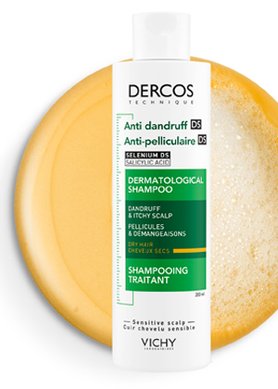
- Oily scalp dandruff: This type of dandruff is characterised by large, yellowish scales that collect on the scalp and hair. Oily hair and dandruff are best tackled with an anti-dandruff shampoo that’s formulated with an oil-regulating ingredient (such as salicylic acid) alongside selenium disulfide. The Dercos Anti Dandruff DS Shampoo for Normal to Oily Hair utilises this harmonious pairing to target the root cause of dandruff and exfoliate dead skin cells from the scalp.
- Dry scalp dandruff: Presenting as small white flakes, dry scalp dandruff occurs when the scalp is lacking moisture. You’ll need anti-dandruff shampoo that’s specifically designed for dry scalps, like Dercos Anti-Dandruff DS Shampoo for Dry Hair. This formula tackles dandruff flakes while nurturing dry hair.
- Sensitive scalp dandruff: If you can’t categorise your dandruff as either dry or oily, see if you can identify any redness, tingling or other sensations of discomfort. If yes, your dandruff might be of the sensitive variety, triggered by an underlying dermatological concern. Consider incorporating the Dercos Anti-Dandruff Shampoo For Sensitive Scalp into your hair care routine. The formula utilises piroctone olamine and bisabolol to address dandruff while improving scalp comfort.
How long should I use anti-dandruff shampoo?
Armed with the right formula, you can start tackling your dandruff head on. But how long does anti-dandruff shampoo take to work? And how often should you use it?
Well, we can separate anti-dandruff hair care into two phases: targeting and maintenance. Let’s unpack your how fast dandruff shampoo works with the right washing schedule and technique.
- Targeting phase: In this initial phase, you should use your anti-dandruff shampoo three times per week, for four weeks. To apply, simply massage the shampoo onto wet hair, leave for two minutes, then rinse.
- When to expect improvement: From the first use of Dercos anti-dandruff shampoo, you will notice your scalp feels cleaner and more comfortable, with a visible reduction in dandruff*. After four weeks, the scalp microbiome is rebalanced**.
- Maintenance phase: Continual use of your anti-dandruff shampoo once a week will help prevent relapse.
*Consumer test on 262 subjects after two weeks of regular use.
**Cosmeto clinical study, 56 subjects with three applications a week for four weeks.
We hope you now feel more confident in the effects of anti-dandruff shampoo, how it works, and which scalp-supporting ingredients to look out for. Next, join us as we put all the pieces together to find out how to prevent dandruff from forming.
1https://pubmed.ncbi.nlm.nih.gov/16382685/
2https://pmc.ncbi.nlm.nih.gov/articles/PMC2887514/
3https://pubmed.ncbi.nlm.nih.gov/34424549/